

Introduction
Institutions are often described as neutral, fair, and objective. Schools, workplaces, healthcare systems, and legal frameworks are designed to operate on rules and policies rather than emotions. Yet for many people, lived experience tells a different story. Beneath formal procedures, patterns of unequal treatment quietly exist. These patterns are what we call institutional bias.
Personal narratives play a critical role in revealing these hidden realities. While statistics and reports can point to disparities, it is personal storytelling that makes those disparities impossible to ignore. Memoirs, essays, and first-hand accounts give bias a human face. Sharon Marie Chester’s Memoirs of an Accidental Abolitionist is one such example, showing how lived experience can challenge systems that otherwise appear unquestionable.
This article explores how personal narratives help expose, challenge, and ultimately fight institutional bias.
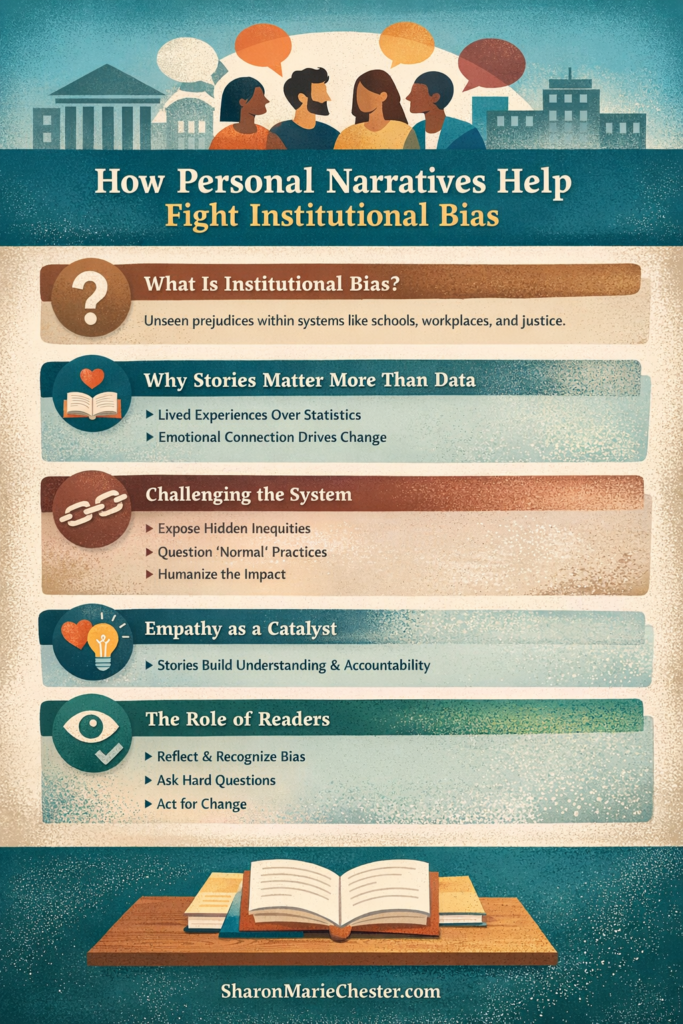
What Is Institutional Bias? (In Simple Terms)
Institutional bias occurs when systems consistently advantage some groups while disadvantaging others, even when discrimination is not intentional. These biases are built into processes, norms, and decision-making structures.
For example:
- A workplace promotion system that favors familiarity over fairness
- Educational policies that overlook cultural or economic barriers
- Legal systems that treat similar cases differently based on background
Because these systems operate “by the book,” bias can go unnoticed. It is often dismissed as a coincidence or individual failure rather than a systemic issue. This is where personal narratives become essential.
Why Data Alone Often Fails to Create Change
Data is important. Research, statistics, and reports help identify trends and patterns. However, numbers alone rarely create emotional urgency.
A statistic may reveal inequality, but it does not convey what inequality feels like. It does not capture the exhaustion, confusion, or quiet harm experienced by individuals navigating biased systems.
Personal narratives bridge this gap. When readers encounter real stories, bias becomes tangible. It stops being abstract and starts being personal. Stories move conversations from “Is this real?” to “How did this happen, and why?”
The Power of Lived Experience

Lived experience carries a kind of credibility that cannot be replicated. It speaks from within the system rather than observing it from the outside.
When someone shares how policies affected their life, they reveal how institutions function in practice, not just in theory. These narratives:
- Highlight inconsistencies between policy and reality
- Reveal unintended consequences of “neutral” rules
- Show how repeated small disadvantages create long-term harm
Memoirs like Memoirs of an Accidental Abolitionist demonstrate how awareness often begins not with ideology, but with lived moments that cannot be explained away.
How Personal Narratives Challenge Dominant Systems
Dominant systems rely on familiarity and repetition. “This is how things have always been done” becomes a shield against accountability.
Personal narratives disrupt that comfort. They challenge accepted norms by presenting evidence that contradicts institutional self-image. When a system claims fairness, and a story demonstrates harm, the contradiction forces reflection.
Stories do not attack systems directly. Instead, they ask difficult questions:
- Who benefits from this structure?
- Who is excluded or overlooked?
- Why does the outcome repeat across different lives?
These questions are harder to dismiss than accusations.
Empathy as a Catalyst for Institutional Change

Empathy is often misunderstood as a soft emotion. In reality, empathy is a powerful catalyst for change.
When decision-makers, educators, or leaders encounter personal narratives, they are more likely to reconsider policies and assumptions. Empathy encourages accountability, not guilt, but responsibility.
Stories help people see beyond their own experience. They encourage listening instead of defensiveness. Over time, empathy-driven awareness can influence cultural shifts within institutions.
Memoirs as Tools for Awareness and Accountability
Memoirs are especially effective because they combine reflection with honesty. They do not claim objectivity; instead, they offer truth through perspective.
Books like Memoirs of an Accidental Abolitionist document experiences that might otherwise be forgotten or dismissed. They preserve voices that challenge dominant narratives and ensure that institutional harm is recorded, not erased.
Memoirs also invite readers into self-examination. They ask not only “What is broken?” but also “What is my role within this system?”
Why Stories Are Harder to Ignore Than Policies
Policies can be debated. Stories linger.
A policy may be revised or reworded, but a personal story stays with the reader. It resurfaces during conversations, decisions, and moments of doubt. Stories humanize consequences in ways policies never can.
This lasting impact is why narratives are so effective in driving long-term awareness. They plant questions that continue to grow.
The Role of Readers in Breaking Institutional Bias
Reading personal narratives is not a passive act. It carries responsibility.
Readers play a role by:
- Reflecting honestly on what they read
- Questioning assumptions they may have accepted
- Recognizing patterns across multiple stories
- Translating awareness into everyday choices
Change does not begin with institutions alone. It begins with individuals who are willing to see clearly.
How Memoirs of an Accidental Abolitionist Fits Into This Conversation
Sharon Marie Chester’s memoir contributes to this broader conversation by demonstrating how ordinary lives intersect with powerful systems. The book does not position activism as a grand identity, but as a natural response to awareness.
Its strength lies in its honesty. It shows how personal narratives can illuminate institutional bias without accusation, allowing readers to reach their own conclusions, often more powerfully than any argument could.
Conclusion
Institutional bias thrives in silence and abstraction. Personal narratives disrupt both.
By sharing lived experiences, stories expose what systems prefer to hide. They foster empathy, encourage accountability, and invite readers into deeper awareness. In a world driven by data and policy, personal narratives remain one of the most effective tools for meaningful change.
Stories do not dismantle institutions overnight, but they begin the work that policies alone cannot.