

Introduction
Some books inform. Others entertain. A few quietly change the way readers see the world. Memoirs of an Accidental Abolitionist by Sharon Marie Chester belongs to the third category.
Rather than presenting activism as a planned identity or dramatic transformation, the memoir explores how awareness often begins unexpectedly. Through personal experience and reflection, the book invites readers to examine their own assumptions, silences, and responsibilities. Its lessons are not delivered as instructions, but as realizations, ones that stay with readers long after the final page.
This article explores the key lessons readers take away from Memoirs of an Accidental Abolitionist and why those lessons feel deeply personal, relevant, and lasting.
Awareness Often Begins by Accident
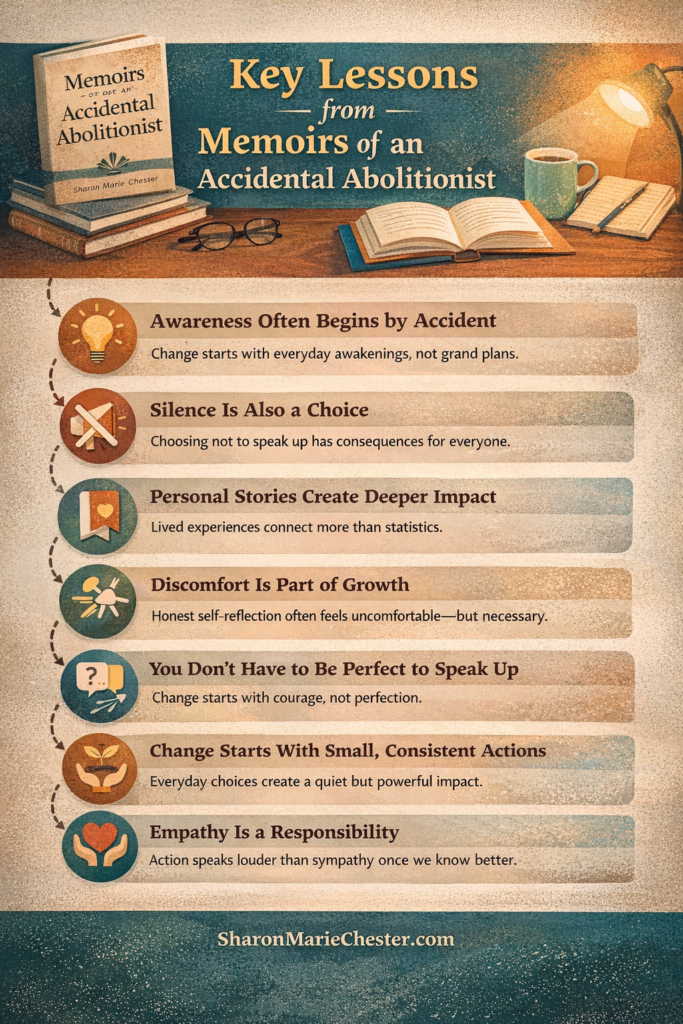
One of the most powerful lessons readers learn is that awareness rarely starts with intention. Many people imagine social justice work as something chosen deliberately by confident, outspoken individuals. This book challenges that belief.
Readers see how awareness can begin with a single moment, conversation, or uncomfortable realization. There is no grand plan, only honesty about how perception shifts over time. This makes the experience relatable. Readers recognize that change does not require a specific personality or background. It often begins simply by paying attention.
Silence Is Also a Choice
Another central lesson is the cost of silence. The memoir does not accuse or shame, but it makes something clear: choosing not to speak is still a decision, and that decision has consequences.
Readers are encouraged to reflect on moments when remaining quiet felt easier than questioning what felt wrong. The book shows how silence can unintentionally protect systems that cause harm. This realization is often uncomfortable, but necessary. Many readers describe this lesson as one of the most confronting and transformative parts of the book.
Personal Stories Create Deeper Impact Than Statistics

While statistics explain problems, stories make them real. Readers learn that personal narratives have a unique power to cut through denial and defensiveness.
Through lived experience, abstract concepts like injustice, privilege, and inequality become tangible. Readers do not just understand the issues intellectually; they feel them. This emotional connection is what makes the lessons memorable. It explains why memoirs often change perspectives more effectively than reports or debates.
Discomfort Is Part of Growth
The book does not attempt to keep readers comfortable. Instead, it presents discomfort as a necessary stage of growth.
Readers learn that questioning long-held beliefs can feel unsettling. Feeling defensive, confused, or uncertain is not a failure, it is a signal that learning is taking place. This lesson resonates deeply, especially for readers who have avoided difficult conversations in the past. Growth, the book suggests, begins where comfort ends.
You Don’t Have to Be Perfect to Speak Up
A recurring theme throughout the memoir is imperfection. Readers learn that waiting to be “ready” or “informed enough” often becomes an excuse for inaction.
The idea of being an “accidental” abolitionist reframes activism as a process, not a performance. Readers see that mistakes, doubts, and learning curves are part of showing up. This lesson removes pressure and replaces it with possibility. Many readers walk away feeling empowered rather than intimidated.
Change Starts With Small, Consistent Actions
Rather than promoting dramatic gestures, the book emphasizes small, meaningful actions. Readers learn that change does not require public recognition or constant confrontation.
Daily choices, listening, questioning, speaking honestly, and refusing to look away carry real weight. This lesson feels achievable. It reassures readers that their actions matter, even when they feel limited in scope.
Empathy Is a Responsibility, Not Just a Feeling

The memoir challenges the idea that empathy ends with understanding. Readers learn that empathy carries responsibility.
Feeling moved by someone’s experience is only the first step. What matters is what follows how awareness influences behavior, decisions, and conversations. This lesson shifts empathy from emotion to action, encouraging readers to consider how they respond once they know better.
The Book Challenges Readers to Look Inward First
Instead of focusing solely on external systems, the book repeatedly turns the lens inward. Readers are asked to examine their own roles, privileges, and assumptions.
This inward focus is what gives the book its lasting impact. It avoids blame and instead invites accountability. Readers often describe this lesson as quietly transformative, prompting reflection long after reading.
Why These Lessons Stay With Readers Long After the Last Page
What makes Memoirs of an Accidental Abolitionist memorable is not a single argument, but its honesty. The lessons unfold naturally, allowing readers to reach their own conclusions.
Because the book does not instruct or lecture, its messages linger. Readers find themselves revisiting its ideas in everyday moments, during conversations, decisions, and moments of silence. This quiet persistence is the book’s greatest strength.
Conclusion
Memoirs of an Accidental Abolitionist teaches readers that awareness does not require perfection, activism does not require labels, and change does not require certainty. Its lessons are grounded in lived experience, making them both accessible and profound.
By encouraging reflection, accountability, and empathy, the book leaves readers not with answers, but with better questions, and the courage to keep asking them.